5 Signs Your Lehi Driveway Needs Replacement in Utah, UT
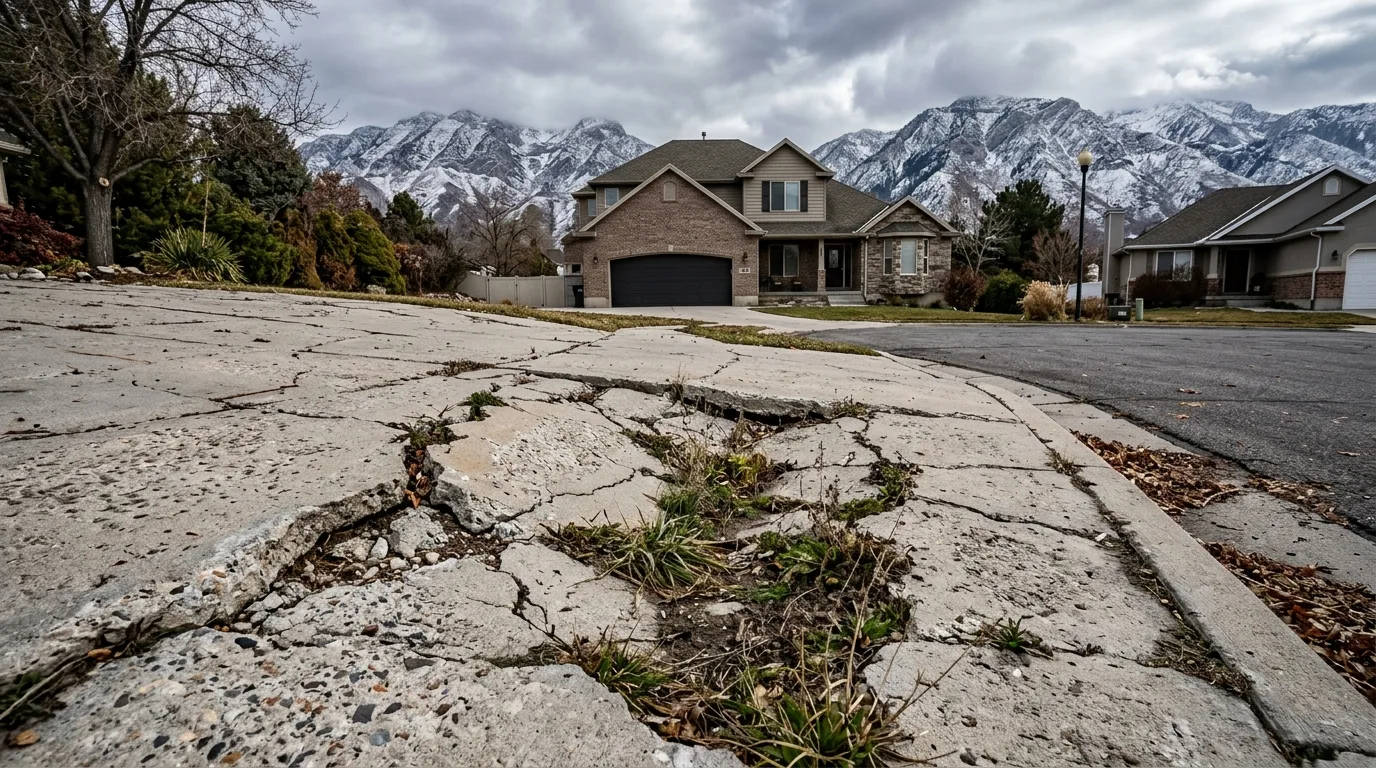
By the time spring arrives in Lehi, many homeowners discover their driveway looks significantly worse than it did before winter. The question is whether what you’re seeing is worth repairing or whether the accumulation of damage has crossed the threshold where replacement makes more financial sense. In this post, we cover 5 clear warning signs — and explain why Utah County’s conditions make driveway deterioration faster here than in most markets.
In this post, we cover the 5 replacement-level warning signs, how to tell repair from replacement, why Lehi’s climate accelerates deterioration, and what replacement realistically costs.
Not Sure If Your Lehi Driveway Needs Repair or Replacement?
Lehi Concrete Pros provides honest assessments — no upsell, no pressure. Call (888) 376-0955.
Why Lehi Driveways Deteriorate Faster Than Average
Utah County’s freeze-thaw cycles are the primary driver of accelerated driveway aging in Lehi. With 126 freezing days annually and winter lows of 20°F, water that enters even hairline surface cracks freezes and expands by roughly 9% in volume — widening and deepening those cracks over successive winters. The blue clay soils common across the Dry Creek and Aspen neighborhoods hold moisture against the underside of concrete slabs, which compounds the freeze-thaw stress from below even as weather attacks from above.
Most Lehi homeowners notice the worst damage in March and April after the ground thaws and reveals what happened underground during winter. Understanding which damage patterns indicate structural failure — versus cosmetic wear — determines whether repair makes sense.
Sign 1: Cracks Wider Than Half an Inch or Cracks That Have Spread Across Multiple Sections
Hairline cracks are normal and repairable. Cracks that have widened to ½ inch or larger indicate structural movement beyond what surface patching can address. Once a crack reaches ½ inch, water has been freely entering the slab for multiple seasons, and the sub-base beneath the crack has likely been eroded or displaced by that water during freeze-thaw cycles.
If similar cracks have appeared in multiple separate sections of your driveway — not just one area — it indicates that the entire slab has been affected by sub-base movement or clay soil pressure, not a localized problem. Patching individual cracks on a driveway that has widespread structural movement is spending money that will not hold through another winter.
Sign 2: Multiple Sections Have Settled, Lifted, or Broken Through the Full Depth
A single settled section of ½ inch or less can often be addressed by slab lifting or leveling. When two or more sections of your driveway have settled more than an inch, heaved due to frost, or cracked completely through the full depth of the slab, the structural integrity of the driveway as a whole is compromised.
Full-depth fractures in multiple locations indicate that the sub-base — the compacted gravel beneath the concrete — has failed or been displaced. In the Traverse Mountain and Silicon Slopes corridor areas of Lehi, where newer construction sometimes corners on base preparation costs, this type of failure can appear in driveways less than 15 years old.
Sign 3: Spalling Across More Than 25% of the Surface
Surface spalling — where the top layer of concrete flakes away and exposes the aggregate beneath — is caused by water that entered the surface, froze, and delaminated the surface paste from the underlying concrete. Localized spalling (a few square feet) is repairable with polymer-modified patch mortar. Spalling that covers more than 25% of the driveway surface indicates that the damage is too widespread for a cost-effective patch repair.
Resurfacing overlays can address widespread spalling if the underlying slab is structurally sound. If the spalling is accompanied by cracking or settlement, the structural issues must be addressed first — resurfacing a compromised slab simply postpones replacement.
Get an Honest Driveway Assessment in Lehi, UT
We tell you what you actually need — not the most expensive option. Call (888) 376-0955.
Sign 4: Water Consistently Pools on the Surface or Drains Toward the House
A properly designed driveway slopes 1–2% away from the home to direct water toward the street or a drainage channel. When sections of the driveway have settled — common in the clay soil neighborhoods of Lehi — that drainage design is compromised. Water that pools on the driveway surface creates standing freeze-thaw exposure that accelerates deterioration. Water that drains toward the foundation creates a far more serious problem: foundation saturation and potential structural damage to the home itself.
Drainage failure in a concrete driveway cannot be corrected by resurfacing. The underlying grade must be corrected through slab lifting, grinding, or replacement. If the root cause is sub-base settlement, only replacement fully resolves it.
Sign 5: The Driveway Is More Than 30 Years Old With No Sealing History
Concrete driveways that have never been sealed — or that haven’t been sealed in 10 or more years — have been allowing water to freely penetrate the surface through every freeze-thaw cycle for years. The compressive damage compounds annually. Even if the surface looks acceptable, the concrete’s internal structure may be significantly weaker than it appears.
A concrete driveway in Lehi can legitimately last 40–50 years with proper sealing and maintenance. A driveway of similar age that was never maintained often reaches end-of-life by 25–30 years, particularly in Utah County’s demanding climate. Before spending money on extensive repairs to an old unsealed driveway, get an honest assessment of the concrete’s condition below the surface.
How to Tell Repair From Replacement
Repair is appropriate when: damage is cosmetic (hairline cracks, minor spalling, surface discoloration), affects less than 25% of the surface, and the underlying slab is structurally sound with no signs of sub-base failure.
Replacement is appropriate when: widespread cracking, multiple settled sections, drainage failure, or full-depth fractures indicate that the slab as a whole is no longer performing its structural function. A repair that costs more than 40–50% of replacement cost is rarely a good investment when underlying conditions haven’t been corrected.
Frequently Asked Questions
How much does driveway replacement cost in Lehi?
A standard two-car concrete driveway replacement in Lehi runs $5,500–$9,000 installed including demolition of the old slab. See our full concrete driveway cost guide for Lehi for detailed pricing.
Can spalling be repaired without replacing the whole driveway?
Yes — if spalling covers less than 25% of the surface and the underlying slab is structurally sound, a resurfacing overlay can extend service life by 5–10 years. If cracking or settlement accompanies the spalling, the structural issue must be resolved first.
Is replacement or repair better for an old Lehi driveway?
If your driveway shows multiple replacement signs — widespread cracking, settlement, drainage failure, spalling across more than 25% — replacement is typically the better long-term investment. Repairs that don’t address root causes will fail faster in Utah County’s climate.
Related:
- Concrete Driveway Cost in Lehi UT: 2026 Pricing Guide
- How Long Does a Concrete Driveway Last in Utah’s Climate?
- When to Repair vs. Replace Concrete in Lehi
Honest Driveway Assessments in Lehi, UT
Call Lehi Concrete Pros at (888) 376-0955 for a free evaluation. We serve all of Utah County.