Why Lehi, UT Homes Need Rebar in Concrete: A Soil Guide
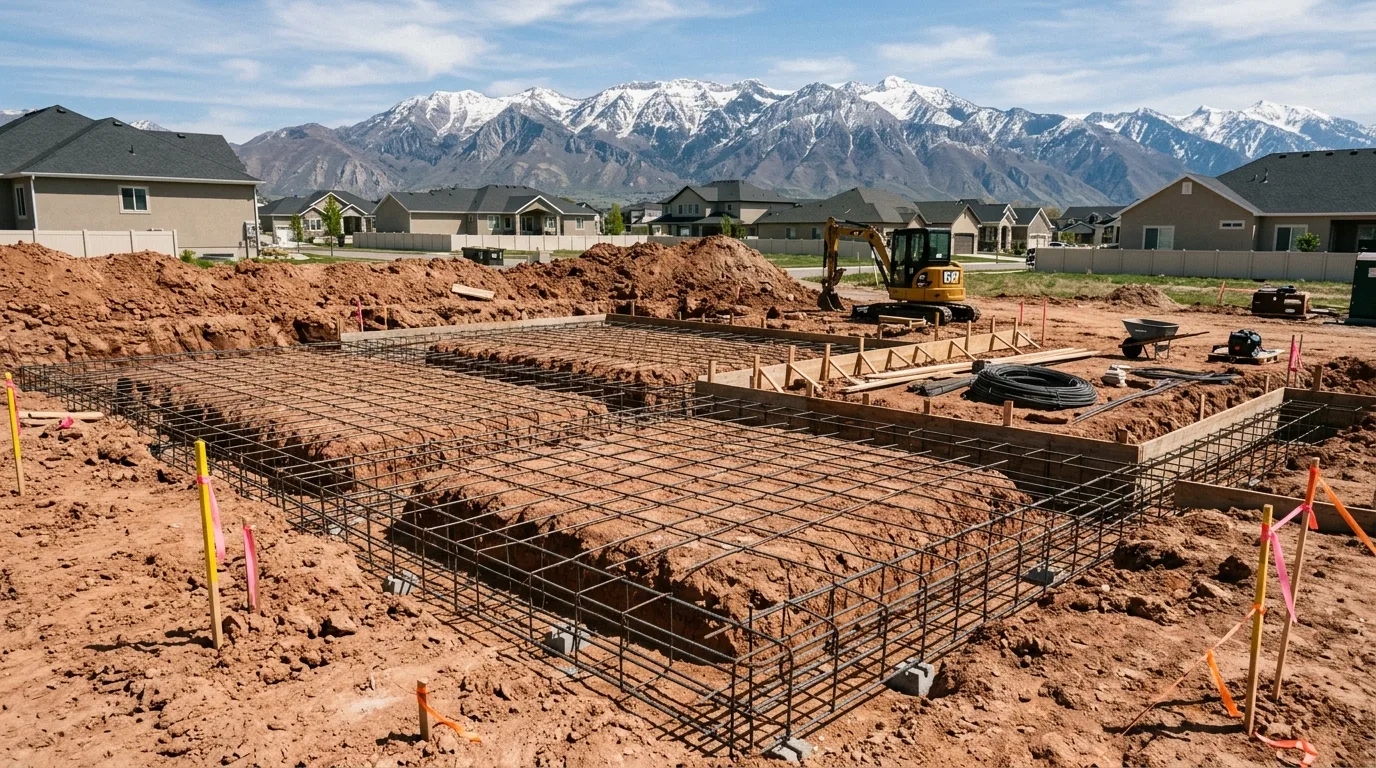
If a contractor quotes you a concrete driveway, patio, or slab in Lehi without mentioning rebar or fiber reinforcement, that’s a red flag worth taking seriously. Utah County’s soil and seismic conditions make concrete reinforcement not just advisable — in many applications it’s the difference between a 40-year slab and a 10-year one. This guide explains why, in terms that don’t require an engineering degree.
In this post, we cover how Utah County’s clay soils create concrete stress, what Seismic Design Category D2 means for residential concrete, what types of reinforcement work for which applications in Lehi, and the specific questions to ask any concrete contractor about their reinforcement spec.
Get Properly Reinforced Concrete in Lehi, UT
Lehi Concrete Pros — every pour reinforced for Utah County's specific conditions. Free estimates at (888) 376-0955.
Why Lehi’s Soil Conditions Make Reinforcement Critical
Concrete is very strong in compression — it handles downward loads well. But it is weak in tension — forces that try to pull it apart from below or from the sides. This is exactly the kind of force that Utah County’s blue clay soils apply to concrete slabs throughout the year.
When Lehi’s spring snowmelt saturates the clay under a slab, the clay absorbs water and expands — pushing upward against the underside of the concrete with significant force. When summer drought arrives, that same clay shrinks and pulls away, creating voids beneath sections of the slab. When winter arrives and frost penetrates to the 30-inch line, the expansion works from the surface down. Each of these cycles applies tensile stress to unreinforced concrete — stress it wasn’t designed to resist on its own.
Reinforcement solves this by adding tensile strength to the concrete system. Rebar or fiber acts as an internal skeleton that holds the slab together even when soil movement creates tensile stress. A reinforced slab that develops a crack due to clay soil movement holds together across the crack; an unreinforced slab separates and begins differential settlement.
Seismic Design Category D2: What It Means for Your Concrete
Lehi is assigned Seismic Design Category D2 by the International Building Code because of its proximity to the Wasatch Fault Zone — the same fault system that runs through the Salt Lake metropolitan area. Category D2 is a high seismic zone, comparable to many areas of California.
For structural concrete — foundations, retaining walls, and any slab attached to the structure — D2 requires more rebar density than the codes in lower-seismic regions. Specifically: closer rebar spacing, specific hook and splice requirements, and minimum concrete strength specifications. A structural engineer’s design drawings are required for residential foundations in Lehi, and those drawings reflect D2 requirements.
For flatwork — driveways, patios, walkways — the seismic code doesn’t directly specify rebar requirements, but the underlying rationale applies: in a high-seismic zone, concrete that isn’t reinforced is more vulnerable to ground movement during a seismic event. Rebar-reinforced flatwork maintains integrity through the kind of minor ground shifting that would fracture an unreinforced slab. This is one reason why concrete contractors who know this market include reinforcement as standard rather than as an optional upgrade.
Types of Reinforcement and Which Applications They Suit in Lehi
Rebar (deformed steel bar): The most effective reinforcement for residential concrete in Lehi. Standard is #4 rebar (½ inch diameter) at 18-inch centers in both directions for driveways and patios. Foundations use specific bar sizes and spacing per the structural engineer’s specification. Rebar provides maximum tensile resistance and holds sections together even through significant soil movement.
Welded wire mesh (WWM): Less effective than rebar for clay soil applications. Wire mesh resists minor tensile stress but doesn’t provide the holding force to keep sections together under significant soil movement. Appropriate for interior slabs on stable grade but not the best choice for Lehi exterior concrete on clay soils.
Fiber reinforcement: Polypropylene or steel micro-fibers mixed into the concrete. Effective for controlling plastic shrinkage cracking during curing and improving impact resistance. Not a substitute for rebar in slab-on-grade applications on expansive soils. Best used in combination with rebar for premium residential concrete in Lehi.
Post-tension cables: Used in commercial slabs and some high-end residential foundations. Significantly increases tensile strength. Not typical for residential driveways or patios in this market.
Practical Uses: What “Properly Reinforced” Looks Like in Lehi
- Residential driveway: #4 rebar at 18-inch centers, placed 2 inches above the sub-base (centered in a 4-inch slab). Control joints placed every 10–12 feet to direct cracking to planned locations.
- Residential patio: Same rebar spec as driveway. For patios with integrated steps, the step footings extend below the 30-inch frost line.
- Foundation (stem wall): Per structural engineer’s Seismic D2 drawings — minimum #5 rebar at 12-inch vertical centers in walls, specific horizontal reinforcement at top and mid-height, specific hook and splice lengths.
- Commercial slab: Specified by structural engineer based on design loads. Typically #5 or #6 rebar at closer spacing than residential, plus fiber reinforcement in many Lehi commercial applications.
Get a Concrete Estimate with Proper Reinforcement Specs in Lehi
Call Lehi Concrete Pros at (888) 376-0955. We spec every job for Utah County's conditions.
How to Verify Your Contractor’s Reinforcement Spec
The best way to verify that a concrete contractor is doing the job right is to ask these specific questions before signing any estimate:
- What rebar size and spacing are you using for this slab? (Expect “#4 at 18 inches” or similar specificity — “standard” is not an answer)
- Where will the rebar be positioned in the slab depth? (Should be 2 inches above the sub-base in a 4-inch slab)
- Are you using rebar or wire mesh? (Rebar is preferable for clay soil conditions)
- Where are control joints placed and how deep? (Every 10–12 ft, cut to 1/4 the slab depth)
A contractor who can answer all four questions specifically and confidently is doing the job correctly. A contractor who responds with vague answers like “we do it right” or “I don’t worry about that” is a contractor to look elsewhere.
Frequently Asked Questions
Is fiber concrete a substitute for rebar in Lehi?
No — fiber reinforcement reduces plastic shrinkage cracking during curing and improves impact resistance, but it does not provide the tensile holding force that rebar provides against clay soil movement. Fiber can be used as an additive alongside rebar for premium results, but it’s not a substitute for rebar on Utah County’s expansive soils.
Does a concrete patio in Lehi really need rebar?
A concrete patio on Utah County’s clay soils performs significantly better with rebar reinforcement than without it. The difference may not be visible for 5–7 years, but by 10–15 years, unreinforced patios on clay soil typically show more cracking and differential movement than reinforced slabs. The cost difference for adding rebar to a patio is typically $0.50–$1.50 per square foot — a small investment relative to the improved performance over 30+ years.
What happens if concrete was poured without rebar in Lehi?
An unreinforced concrete slab on Utah County clay soils will typically function adequately for 5–10 years before differential cracking from soil movement becomes apparent. Once full-depth cracks develop and sections begin to separate, repair cannot restore the slab to its original integrity. The correct fix is eventual replacement with proper reinforcement. Regular sealing delays the surface deterioration but cannot prevent the structural cracking caused by soil movement on an unreinforced slab.
Related:
- When to Repair vs. Replace Concrete in Lehi: A Guide
- Best Time to Pour Concrete in Lehi, Utah
- Do I Need a Permit for Concrete Work in Lehi?
Every Lehi Concrete Pour Reinforced for the Real Conditions
Call Lehi Concrete Pros at (888) 376-0955. Proper specs, honest advice, free estimates.