Stamped Concrete vs Pavers in Lehi, UT: Which Is Right?
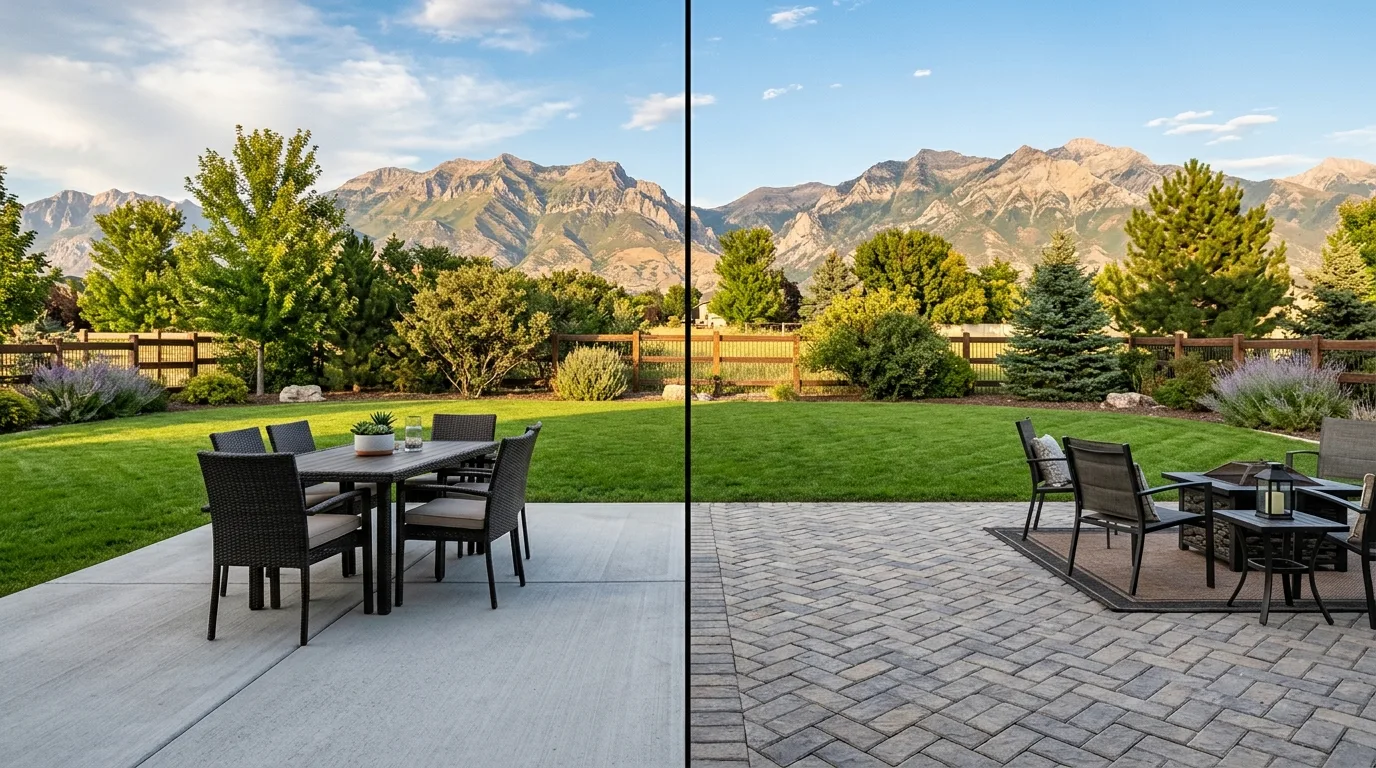
Should you install stamped concrete or pavers for your Lehi patio? Both options look great when freshly installed — but Utah County’s freeze-thaw cycles, clay soils, and 228 sunny days per year treat each material very differently over time. This post gives you the honest comparison that helps Lehi homeowners make the right choice.
In this post, we cover upfront cost comparison in Utah County, winter performance in Lehi’s climate, long-term maintenance requirements, and which application each material is best suited for.
Get a Stamped Concrete Estimate for Your Lehi Patio
Lehi Concrete Pros — pattern samples, written estimates, and Utah County expertise. Call (888) 376-0955.
How Utah County’s Conditions Affect This Choice
The most important context for the stamped concrete vs. pavers decision in Lehi is how each surface behaves during the 126 freeze-thaw cycles the area experiences annually. Water behaves differently between jointed paver surfaces and monolithic concrete slabs — and that difference has real long-term consequences that are worth understanding before committing to either surface.
Lehi’s expansive clay soils also affect both options differently. Pavers are individual units that can shift independently when clay soil beneath them expands and contracts. Stamped concrete is a continuous slab that moves as one unit — which is a strength when the sub-base is properly prepared, and a liability when it isn’t.
Upfront Cost: Stamped Concrete vs. Pavers in Lehi
Stamped concrete: $8–$21 per square foot installed, depending on pattern complexity. A 400 sq ft patio runs $3,200–$8,400.
Concrete pavers: $15–$30 per square foot installed in Utah County. The same 400 sq ft patio runs $6,000–$12,000. Paver installation costs more because each unit must be individually set on a compacted sand bed, requiring significantly more labor than a monolithic pour.
Natural stone pavers (flagstone, travertine): $20–$40+ per square foot installed. Premium price point well above either option.
Stamped concrete is almost always less expensive than pavers for the same coverage area, often by 30–50%.
Winter Performance in Lehi’s Climate
Stamped concrete in winter: The primary winter vulnerability of stamped concrete is the sealed surface. A properly applied freeze-thaw rated sealer prevents water from penetrating the surface, protecting both the color layer and the structural concrete from freeze-expansion damage. The monolithic slab doesn’t allow water infiltration between joints. Properly sealed and maintained stamped concrete in Lehi performs very well through winter.
Pavers in winter: Individual paver joints are filled with polymeric sand or similar jointing material that can degrade over time, allowing water infiltration between units. Water that enters the joint base freezes and can displace individual pavers, creating uneven surfaces that develop progressively. In Lehi’s climate — particularly in the Dry Creek and Aspen neighborhoods with higher clay content — paver frost heave is a documented maintenance issue that requires periodic re-setting of displaced units.
The advantage goes to stamped concrete for winter performance in Lehi, assuming proper sealing is maintained.
Long-Term Maintenance Comparison
Stamped concrete maintenance:
- Reseal every 2–3 years with freeze-thaw rated sealer (approximately $200–$500 per application for a 400 sq ft patio)
- Fill any opened control joints before winter
- Periodically clean with pH-neutral cleaner to maintain sealer performance
Paver maintenance:
- Re-apply jointing sand every 2–4 years as it migrates and washes out
- Re-set any frost-displaced or settled pavers (common in Utah County after hard winters)
- Seal every 2–3 years if using sealed pavers
- Weed management in joints — pavers that aren’t sealed can develop weed growth in joints within 2–3 years in Lehi’s climate
Both surfaces require regular maintenance. Pavers require more frequent physical intervention (re-setting, sand replenishment) while stamped concrete requires periodic resealing as the primary maintenance item.
Practical Uses: When Each Material Makes More Sense in Lehi
- Budget-conscious patio upgrade: Stamped concrete wins on cost for equivalent coverage. For most Lehi homeowners adding an outdoor living space, stamped concrete delivers premium appearance at lower cost.
- Permeable drainage applications: Permeable pavers allow water to infiltrate through the joint system, which can be valuable in areas with drainage restrictions. Stamped concrete is impermeable.
- Large-scale decorative patios: Stamped concrete is more cost-effective for large patio areas. For small entry features or accent areas, pavers’ unit cost matters less.
- DIY-friendly future repairs: Individual paver replacement is possible for a homeowner; concrete repair or resurfacing is a professional job. If self-repair appeal is a priority, pavers have an advantage.
- Pool deck applications: Stamped concrete offers a continuous non-slip surface without the sand joints that deteriorate under chlorine splash. Most Utah County pool decks use concrete rather than pavers.
Compare Patio Options for Your Lehi Home
Lehi Concrete Pros — honest advice, free estimates, stamped concrete expertise. Call (888) 376-0955.
How to Decide: A Simple Framework for Lehi Homeowners
Choose stamped concrete if: your primary goals are cost-efficiency and low maintenance for a large patio area, you want design flexibility in pattern and color, and you’ll commit to resealing every 2–3 years.
Choose pavers if: permeable drainage is a requirement, you want the ability to replace individual units without professional help, or you’re working on a small feature area where the higher per-unit cost is manageable.
Either choice requires the same quality sub-base preparation on Utah County’s clay soils — don’t let a paver contractor skip base prep because “it’s just pavers.” The foundation below is what determines longevity regardless of surface material.
Frequently Asked Questions
Does stamped concrete fade in Lehi’s intense summer sun?
Unsealed stamped concrete does fade from UV exposure in Lehi’s 228 sunny days per year. A properly applied sealer with UV protection dramatically reduces this fading. Resealing every 2–3 years is the primary maintenance required to maintain color vibrancy.
Can pavers be replaced more easily than stamped concrete if damaged?
Yes — individual paver units can be removed and replaced if damaged. Stamped concrete repair requires matching the existing color and pattern, which is technically challenging. For homeowners concerned about localized damage repair, pavers offer more straightforward individual replacement.
Which surface is safer for children and elderly family members?
Both stamped concrete and properly textured pavers provide non-slip surfaces. Stamped concrete patterns with a brushed or light broom texture have good slip resistance. Pavers with textured surfaces perform similarly. The key risk for pavers in Lehi is frost-displaced units that create trip hazards — stamped concrete’s monolithic surface eliminates this specific risk.
Related:
- Stamped Concrete Patio Cost in Lehi: Complete 2026 Guide
- 6 Popular Stamped Concrete Patterns for Lehi Homes
- How to Maintain Your Stamped Concrete Patio in Utah Winters
Stamped Concrete Patios Built for Lehi's Climate
Call Lehi Concrete Pros at (888) 376-0955. Free estimates, Utah County expertise, lasting results.