New Construction Homes in Lehi, UT Need Concrete Driveways
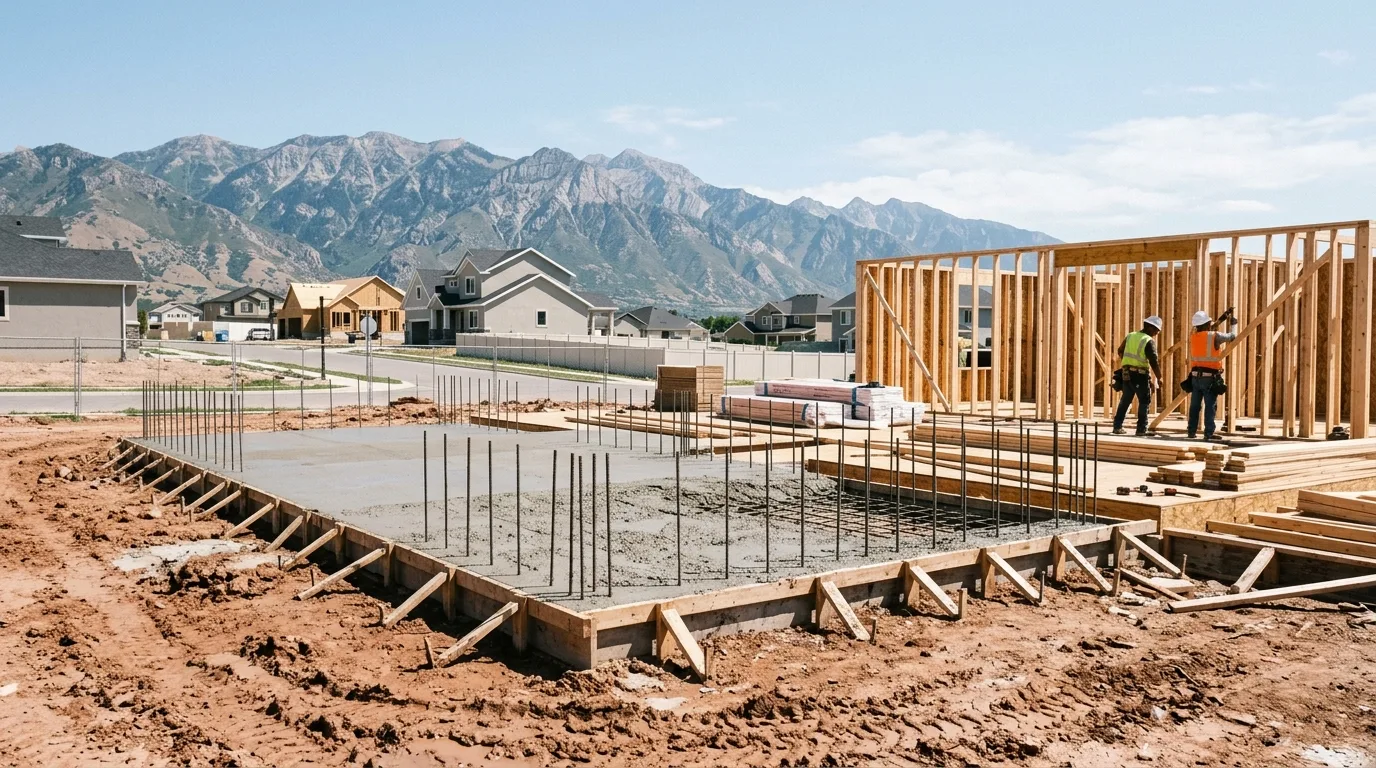
Lehi is one of the fastest-growing cities in Utah — with thousands of new homes going up in Traverse Mountain, the western corridors near Saratoga Springs, and Eagle Mountain each year. The driveway decision for a new build is different from a replacement decision: you’re choosing once, and you’ll live with that choice for the life of the home. Here’s why concrete is the right call for new construction in this market.
In this post, we cover why new Lehi builds should prioritize concrete, the specific soil and seismic factors that make concrete superior here, the cost comparison for new construction, and what to ask your builder.
New Build Driveway in Lehi? Get a Concrete Quote.
Lehi Concrete Pros — free estimates for new construction driveways throughout Utah County. Call (888) 376-0955.
Why New Construction Is the Best Time to Choose Concrete
When you’re building a new home in Lehi, the driveway surface decision happens before the concrete slab is ever poured. The excavation is happening anyway; the grade is being established; the curb cut is being designed. Adding a properly specified concrete driveway at this stage costs significantly less than replacing an asphalt driveway in 15 years — because there’s no demo cost, no existing material to haul away, and the base preparation is being done in the same mobilization as the rest of the site work.
New construction homebuyers in Lehi’s silicon slopes corridor and in the growing western subdivisions frequently encounter builders who offer asphalt driveways as the standard inclusion. Understanding why concrete is worth the upgrade — and exactly what questions to ask — can save you from a replacement decision within the first decade of ownership.
Utah County’s Clay Soils Make Base Preparation Non-Negotiable
The blue clay soils found throughout Utah County expand when wet and contract when dry — a cycle that puts constant pressure on driveways poured over inadequate sub-base preparation. New construction in Lehi’s rapidly growing areas sometimes involves sites where grading has disturbed the soil significantly, creating conditions where additional compaction and granular base depth are needed beyond what a standard spec calls for.
At new construction stage, the cost to specify a deeper compacted gravel base and proper moisture barrier is marginal. On an installed driveway that begins failing because of clay soil movement, the only fix is removal and replacement — at full cost. The Thanksgiving and Dry Creek neighborhoods, where clay content is particularly high, illustrate this clearly: well-prepared new driveways in these areas that are 20 years old still look excellent, while nearby driveways installed with minimal base preparation show significant settlement and cracking.
Seismic Design Category D2 Affects Your Foundation — and Your Driveway
Lehi’s Seismic Design Category D2 classification requires structural concrete foundations to meet specific reinforcement standards. While driveways are not typically subject to the same seismic specifications as structural elements, the underlying rationale — that Utah County soils move and concrete without reinforcement is vulnerable — applies to driveways as well. Rebar or fiber-reinforced concrete driveways resist the cracking caused by soil movement far better than unreinforced slabs, and in a new construction context this upgrade is inexpensive relative to the long-term benefit.
Practical Uses: Why Concrete Makes Sense for Lehi’s New Build Market
- Long-term ownership: Families buying new homes in Lehi with 30-year plans benefit most from concrete’s 40–50 year lifespan vs. asphalt’s 15–20 year cycle.
- HOA compliance: Many Lehi-area HOAs specify concrete driveways for aesthetic uniformity. Checking HOA requirements before the builder pours asphalt saves the cost of replacement.
- Resale value: Concrete driveways photograph better, require no visible maintenance, and are a consistent positive on real estate listings in Utah County’s competitive market.
- Winter deicing compatibility: Concrete handles ice melt products better than asphalt, which softens from chemical deicers in addition to heat. This is particularly relevant in Lehi where winter maintenance is a multi-month reality.
Get a New Construction Driveway Quote for Your Lehi Home
Call Lehi Concrete Pros at (888) 376-0955. We work with builders, GCs, and direct homeowners throughout Utah County.
What to Ask Your Lehi Builder About the Driveway
Before your builder pours an asphalt driveway as a standard inclusion, ask these specific questions:
- What is the cost difference to upgrade to concrete? (Often $1,500–$3,500 on a standard lot)
- What sub-base depth and compaction spec is being used? (Ask for the number — “standard” is not an answer)
- What PSI specification is the concrete? (Minimum 3,000; 4,000 preferred in Utah County)
- Does the spec include rebar or fiber reinforcement?
- Is the driveway sloped away from the home at 1–2%?
A builder who can’t answer questions 2–4 specifically is likely not putting adequate attention into the driveway specification. This matters because once the slab is poured on a new build, the base preparation cannot be corrected without full removal.
Cost of Concrete vs. Asphalt for New Construction in Lehi
For a new home in Lehi, the cost difference between concrete and asphalt driveways is typically $1,500–$4,000 depending on driveway size — often less than 1% of the total home cost. Over a 30-year ownership period, the total cost difference (including asphalt’s required resurfacing and earlier replacement) typically favors concrete by $3,000–$8,000 in this climate. For most new build buyers in Lehi’s market, this calculation makes the upgrade straightforward.
Frequently Asked Questions
Does Lehi City have concrete requirements for new construction driveways?
Lehi City does not mandate concrete vs. asphalt for residential driveways. However, driveway apron connections to the public street require permits, and construction standards for the approach area apply. Check with Lehi City Building and Inspections through the iWorQ portal for any HOA or subdivision-specific requirements in your development.
How soon after moving in can my new concrete driveway be used?
New concrete driveways should be walked on after 7 days and driven on after 28 days. For new construction, this window is typically designed into the construction timeline with no impact on move-in.
Can I choose stamped concrete for my Lehi new build driveway?
Yes — stamped concrete is a popular upgrade in Lehi’s premium subdivisions, particularly in the Traverse Mountain corridor. It adds $3–$13 per square foot over plain gray concrete but significantly enhances curb appeal on a brand-new home.
Related:
- Concrete Driveway Cost in Lehi UT: 2026 Pricing Guide
- Concrete vs. Asphalt Driveway: Which Is Better for Lehi Homes?
- How Long Does a Concrete Driveway Last in Utah’s Climate?
Build Your Lehi Home's Driveway Right the First Time
Lehi Concrete Pros — free estimates, proper specs, and 30-year results. Call (888) 376-0955.